Light in General
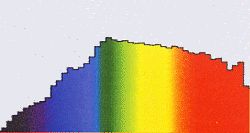
The Spectrum of Sunlight
|
| The Electromagnetic Spectrum
|
|
|
|
| 1 mm - more than 10 km
|
radio waves
|
| 0.5 mm - 1m
|
micro waves
|
| 761 nm - 5 mm
|
infrared radiation
|
|
|
|
| 760.8 nm
|
visible light, dark red
|
| 686.7 nm
|
visible light, red
|
| 656.3 nm
|
visible light, red
|
| 589.3 nm
|
visible light, yellow
|
| 527.0 nm
|
visible light, green
|
| 486.1 nm
|
visible light, blue green
|
| 430.8 nm
|
visible light, blue
|
| 396.8 nm
|
visible light, purple
|
| 393.4 nm
|
visible light, purple
|
|
|
|
| 1nm - 393 nm
|
ultraviolet radiation (UVA,UBD,UVC)
|
| 0.001nm - 1 nm
|
X-rays
|
smaller than 0.000001 nm
- 0.1 nm
|
gamma-rays
|
Quantifying visible Light
The first standard chosen was a source that was familiar and common to everybody: a candle. It was a specifically sized candle with specific material and molded in a specific way. The amount of light emitted from such a candle became the first unit of 'brightness'. It was called 'one candlepower'.
Imagine such a candle at the center of an darkened room, the energy of this candle is radiating equally in all directions. The farther the distance from its flame, the less light it appears to be shedding.
Light from a point source (the candle) radiates outward in all directions such that it uniformly illuminates the surface of an ever expanding sphere. As the radius of that sphere gets larger, the surface area grows even more and thus the energy from the candle is spread ever thinner.
This is the 'Inverse Square Law' (the radius of the sphere is R,
the surface of the sphere is 4x R2).
Basic Terms
Luminous Flux (lumen)
The total light output from electric sources is expressed in lumens.
Lumens = {Lux * Area} / {Screen Gain}
Luminance (NIT, cd/m2)
The specific light that comes off the surface of a lighting device, whether off a filament, light bulb, lens, louver, tabletop, etc. Luminance varies with the direction and its gloss characteristics. Luminance is measured in candela per square foot.
Illuminance (lux)
The density of luminous flux on a surface, is measured in lux (one lumen per square meter) or footcandles (one lumen per square foot).
Candela
The unit of the intensity of light at the source equal to the amount of light from the flame of a candle in any direction.
Footcandle
The measure for the density of light as it reaches a surface. One footcandle equals one lumen per square foot. Footcandle is sensitive to the inverse square law and the angle at which the light reaches the surface.
Color Temperature
The color of a light source relative to a black body at a particular temperature expressed in degrees Kelvin (°K). The range of used color temperatures is about 2800°K to 6000°K.
Color Rendering Index (CRI)
The ability of a light source to produce color in objects. The CRI is expressed on a scale from 0-100, where 100 is the best in producing vibrant color in objects.
Luminous Efficiency
Describes the efficiency of a lamp and is is expressed as the ratio of the emitted luminous flux in lumen and the power used in watts.
The theoretically maximum value at 555 nm would be 683 lm/W. Today's lamps vary between 10 and 250 lm/W.
Speed of Light in Vacuum
The speed of light in vacuum is 186,282 miles per second / nearly 300,000 kilometers per second. A light year is the distance light travels in one year at the speed of 186,282 miles per second, about 6 trillion miles.
| Spectral Colors |
| color |
wave length (nanometer) |
freqency (10 exp+12 Hz) |
| Violet |
400-420 |
750-715 |
| Blue |
420-490 |
715-610 |
| Green |
490-575 |
610-520 |
| Yellow |
575-585 |
520-510 |
| Orange |
585-650 |
510-460 |
| Red |
650-750 |
460-400 |
Color Temperature
A measurement of white color chromaticity as a result of a balanced mixture of red, green and blue. Higher color temperature gives bluish white (cool white) and lower color temperature gives reddish white (warm white).
| Color Temperatures of a Candle |
|
Degrees Kelvin |
| Standard Candle |
2000 |
| Candle Flame |
1500 |
| Daylight Color Temperatures |
|
Degrees Kelvin |
| Clear Blue Sky |
8000 to 27,000 |
| Rainy, Misty Daylight |
7200 to 8500 |
| Overcast Daylight |
6500 to 7200 |
| Direct Sun + Clear Blue Sky |
5700 to 6500 |
| Summer Sunlight (9am to 3pm) |
5400 to 5700 |
| Summer Sunlight (before 9am or after 3pm) |
4900 to 5600 |
| Electronic Flash (Typical) |
6200 to 6800 |
| ARC Lamp Color Temperatures |
|
Degrees Kelvin |
| Xenon Arc (unfiltered) |
6000 |
| White Flame Carbon Arc |
5000 |
| Yellow Flame Carbon Arc |
3200 |
| Fluorescent Lamp Color Temperatures |
|
Degrees Kelvin |
| 'True Daylight' Color Match Tubes |
6500 |
| 'Daylight' Cool White Tubes |
4300 |
| 'Warm White' Tubes |
3000 |
| Tungsten Color Temperatures |
|
Degrees Kelvin |
| Photoflood & 3400K Tungsten-Halogen |
3400 |
| Tungsten-Halogen and Photolamps |
3200 |
| Projection Lamps (500 to 1000 Watts) |
2900 to 3000 |
| General Purpose Lamps (200 to 500 Watts) |
2900 |
| Household Lamps (100 to 150 Watts) |
2850 |
| Household Lamps (60 Watts) |
2800 |
| Household Lamps (40 Watts) |
2750 |
Colors in General
For pigment colors, the primary colors are RED, YELLOW, and BLUE. These colors cannot be mixed by any other color. All other colors are combinations of these colors.
Secondary colors are ORANGE, GREEN, and PURPLE, these colors are the combinations of the primary colors: red and yellow = orange, yellow and blue = green, blue and red = purple.
Tertiary colors are YELLOW-ORANGE, RED-ORANGE, RED-PURPLE, BLUE-PURPLE, BLUE-GREEN, and YELLOW-GREEN. These are combinations of the secondary colors.
Complementary colors are the colors that sit opposite to each other on the color wheel. By using colors that are opposite, a color scheme with high contrast will be created: red and green, blue and orange.
|
| Luminance
|
|
Luminance is the amount of visible light leaving a point on a surface in a given direction.
It can be a physical an imaginary surface and the light that leaves the surface can be due to reflection, transmission, and/or emission.
|
| standard unit is candela per square meter (cd/m2)
|
|
| 20 - 90
|
Brightness of Plasma Screens
|
| 55
|
Cinema Screen
|
| 90 - 300
|
CRT, Computer Monitor, Video Display
|
| 31.800
|
Reflecting, Diffusing Surface in Sunlight
|
| 7.600
|
Moon, Clear Sky
|
| 3.100 - 6.900
|
Overcast Sky
|
| 2.100 - 6.000
|
Clear Sky
|
| 1.65 Giga
|
Sun at Zenith
|
|
| Illuminance
|
|
Illuminance is the total amount of visible light illuminating a point on a surface from all directions above the surface. The surface can be a physical or an imaginary surface. Illuminance is equivalent to irradiance weighted with the response curve of the human eye.
|
| standard unit is Lux (lx) which is lumens per square meter (lm/m2)
|
|
| 1 milli
|
Starlight
|
| 0.1
|
Full Moon
|
| 10
|
Twilight
|
| 1.000
|
Overcast Day
|
| 108.000
|
Direct Sunlight
|